"Captain Tsubasa" Reaches Its 45th Anniversary
──March 2026 witnessed the 45th anniversary of "Captain Tsubasa." Has there been a trick to working on a single title for all this time?
Yoichi Takahashi
It was a lot of trial and error in the beginning, but as I continued to write, Tsubasa and the other characters began to take on lives of their own—it became natural to imagine what they would do in a given situation. It was almost like they started reacting all by themselves.
When they were still in elementary school, there was a certain pressure to create characters that acted like elementary school students, but once they graduated to middle school, and especially once they became international professional athletes, I was able to rely on the natural flow of events. With Tsubasa, for instance, I would think, "He'd probably be this kind of player at this age," or, "He'd probably play for this kind of team."
When it comes to the characters who appeared in the series from the start in particular, they've now grown up, and I've been able to entrust the story to them. So rather than say that I struggled to develop the series over a long period of time, I would say that the series has progressed naturally thanks to the actions of the characters themselves.
──Please tell us about the themes you wanted to incorporate into the series back when "Captain Tsubasa" first began serialization.
Yoichi Takahashi
From the beginning, Tsubasa has always dreamed of both becoming the world’s best and bringing Japan to a World Cup victory. And so the themes included both working hard to achieve your dreams and, because football is a team sport, working together with teammates.
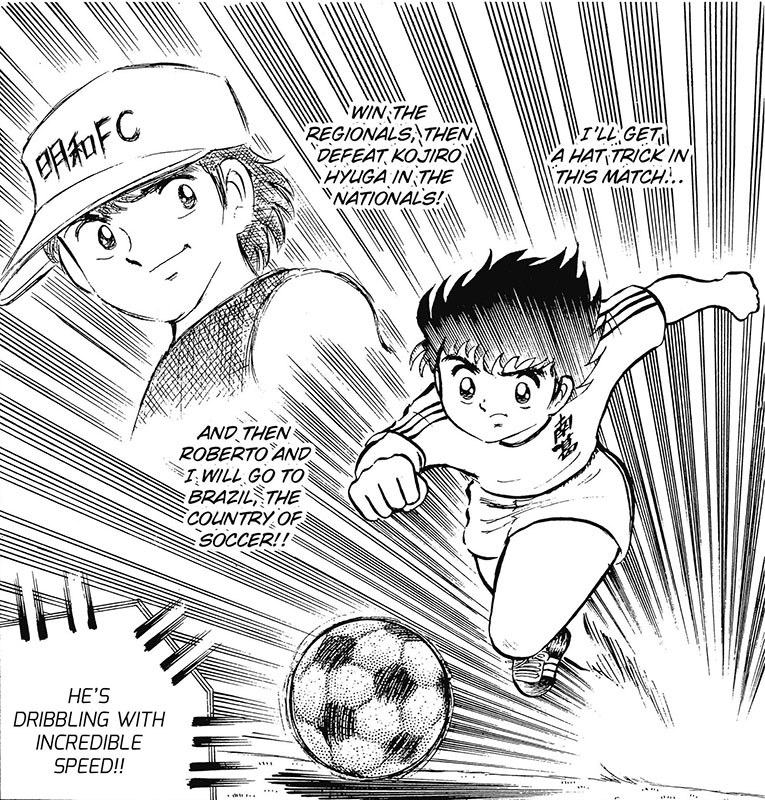
and faces his matches head-on in order to get it!
──In the beginning, Tsubasa and the people around him give off the impression of being good friends. Given the title, did you always imagine he would one day become team captain?
Yoichi Takahashi
Would you believe I hadn't really thought about it, even though the main character in the one-shot before the series was also team captain? (laughs) But the best player on the team is often chosen to be captain, so I did have some inkling that he might become captain one day.
──You’ve written a number of further entries in the series even after "Captain Tsubasa" finished appearing in Weekly Shonen Jump. Have there been any changes in the series since then?
Yoichi Takahashi
The sport of football is incredibly popular all around the world, and there's the international championship known as the World Cup as well. In addition, football has taken root in different countries in ways unique to those countries. I wanted to portray all those varied aspects of football, and I wanted to portray Tsubasa playing in bigger and bigger matches.
When I started writing the "Elementary School" arc, there was no professional league in Japan, and many said it would be difficult for Japan to even qualify for the World Cup. Since then, football in Japan has progressed rapidly. We're regulars at the World Cup, and I now think it's possible for us to win. Actually, when it first became possible for Japan to try and qualify for the World Cup, I thought to myself, "I need to cheer on Japanese football through manga!"
──Even from the start, "Captain Tsubasa" has always seemed to be very polished as a football manga. What aspects did you give the most attention to while writing?
Yoichi Takahashi
I've always loved Shinji Mizushima's baseball manga (such as "Dokaben"), so I think I was influenced by his paneling and structuring. I asked myself, "What would it look like to apply some of the elements of Mizushima's baseball manga to football?" But baseball and football are different sports, so it ended up being quite difficult in practice.
For example, in a baseball manga, you only need to show the characters' upper bodies to portray them throwing and hitting balls. But since football is a sport played with your feet, you have to show the characters' entire bodies. And unlike baseball, the eleven players on the field don't stay in a single location. Even forwards have to fall back depending on the state of the match.
That's why I need constant perspective on the entire field when I'm writing. Even when drawing someone shooting the ball, I need to consider the positioning and movement of every player. That way, if the shot misses, I can imagine which players will move in to take the rebound. That's one of the difficult aspects in which football manga differs from baseball manga.
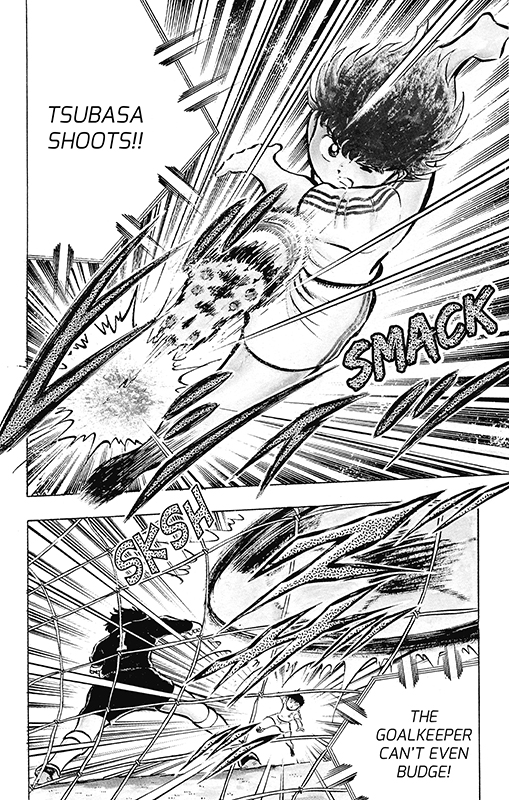
The characters' entire bodies need to fit into the panel from head to toe,
making layout design very difficult!
──Your paneling also reflects the need to draw their entire bodies while also giving them a sense of impact, right?
Yoichi Takahashi
That's right. football also provides more artistic freedom compared to baseball. In baseball, batting stances are fairly standardized, but in football, even a single shot can be made from a variety of different poses. It can be made with the right foot, the left foot, the ball still on the pitch, the ball flying through the air... and so on and so forth. Being free to create whatever poses I want and whatever layout I want is part of the merit of writing a football manga. And part of the fun.
──I imagine the overhead kicks that have shown up since the early stages of the manga reflect that.
Yoichi Takahashi
That pose lets me both give shots an even more dynamic appearance, as well as utilize all kinds of different layouts.
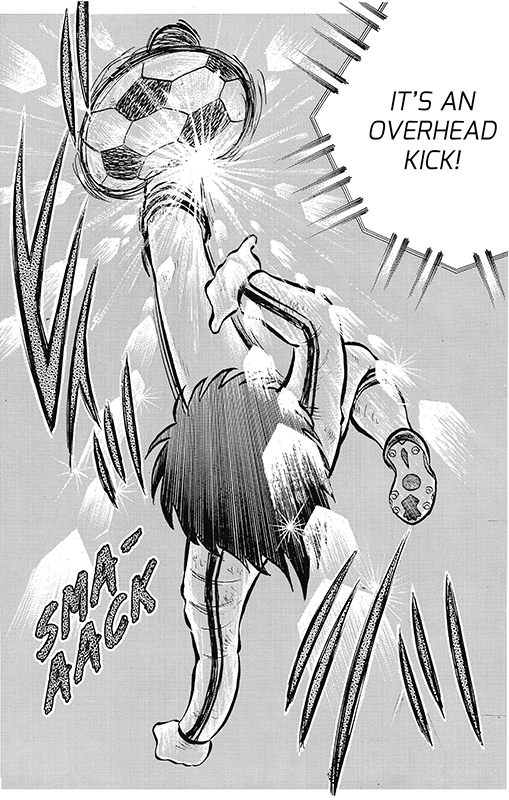
It added an aerial element and brought the match to the next level!
Part 2 will be released on Monday, August 10, —so please look forward to it!!